
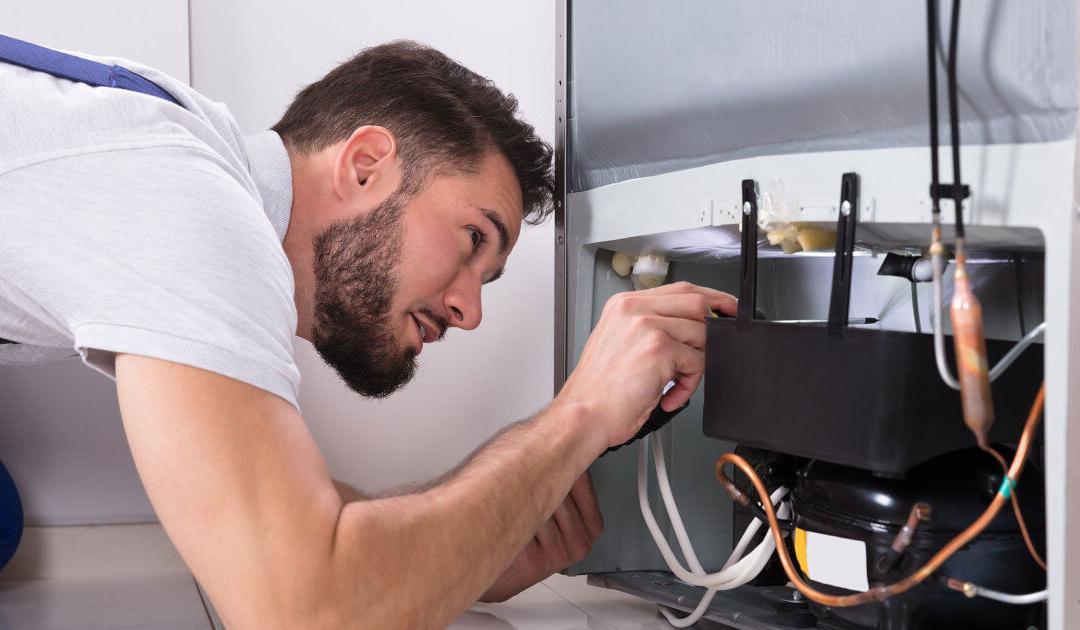
A sharp click at the back of the fridge, a short hum, then nothing: the temperature rises and food starts to warm up. In many cases, the compressor isn’t to blame. The culprit is the starter relay, a small part that gives it the boost it needs to start up.
Replacing it is one of the most accessible refrigerator repairs, as long as you diagnose it correctly first and follow a few precautions. Here’s how.
What does the starter relay do?
On startup, the compressor needs a stronger current than when it’s running. The starter relay, often a PTC-type component, supplies that jolt, then disconnects after a few seconds, once the compressor is up and running.
It’s almost always paired with an overload relay (or thermal protector), which cuts power if the compressor overheats. Depending on the model, the two are combined in a single housing mounted directly on the compressor, at the back bottom of the fridge, or installed separately.
How do you know the relay is the problem?
A failing relay tends to show fairly typical signs:
- a sharp click at the back of the unit, repeating every few minutes;
- a short hum from the compressor, followed by a stop;
- a fridge that’s no longer cooling while the interior light still works normally;
- a relay housing that’s blackened, melted, or smells burnt.
An occasional click when the compressor starts or stops is normal. It’s the repeated click, with the compressor never actually starting, that should raise a flag.
These signs can look like other issues though: a capacitor, a thermostat, a control board or the compressor itself can produce the same symptoms. Replacing a relay without testing it first risks masking the real problem.
Testing is done with a multimeter, with the relay removed and the appliance unplugged. A healthy PTC relay reads, when cold, a resistance of a few ohms to a few dozen ohms depending on the model; an infinite or very high reading points to a faulty relay. Values vary by relay type: when in doubt, it’s best to ask for a diagnosis.
Before you start: precautions
- Unplug the refrigerator. Don’t rely on the thermostat or a closed door: only the unplugged cord actually cuts the power.
- Wait at least 10 minutes after shutdown: the relay housing and the compressor can be very hot.
- Photograph the wiring before removing anything.
- Wear gloves, and never touch the refrigerant circuit’s copper tubing: don’t bend it or pull on it.
- Move the fridge while keeping it upright, without tilting it significantly.
- If your unit has a starter capacitor, it can hold an electrical charge even when unplugged. Don’t handle it yourself: that step is for a technician.
Replacing the starter relay, step by step
- Clear the access panel. Unplug the unit, pull it gently forward to reach the back, then unscrew the panel protecting the compressor, at the bottom.
- Locate the relay. It’s mounted on the compressor’s terminals, under a protective cap. Remove the cap and photograph the position of the wires and connectors.
- Remove the relay. Pull the housing straight toward you, without twisting or forcing it. The compressor’s pins are fragile: never bend them. Pull on the plastic connector, never on the wires.
- Compare with the new part. Same shape, same terminals, same reference number. If the starter relay and overload relay are separate, test the second one too and replace it if needed. Connecting wires can be ordered along with the part.
- Put everything back and check. Insert the relay fully, replace the cap and the panel, then plug the unit back in. The compressor should start within a few seconds and run continuously, without repeated clicking. The temperature can take several hours to drop back down.
The relay’s location and shape vary from one appliance to another. Always follow your model’s manual.
Service Request
Need parts?
Finding the right part
The relay has to match your appliance’s compressor: a “universal” relay isn’t always compatible. Have your model number and serial number ready, found on the label inside the fridge. Our parts department can identify the exact part, then ship it to you or have it ready for pickup. See our refrigerator parts.
When to call a technician
It’s best to stop and ask for help in the following cases:
- the tested relay is in good condition: the problem lies elsewhere (capacitor, thermostat, control board or compressor);
- the clicking returns after installing the new relay;
- the wires are burnt, the connectors are melted, or there’s a burning smell;
- the compressor is hot to the touch and won’t start;
- you can’t find an accessible relay housing, which happens with some variable-speed compressors, or your unit has a capacitor.
Service 2000 provides at-home service across the greater Montreal area and the Quebec City region, with a 1-year warranty. Discover our refrigerator repair service or book online.
Keep in mind: this repair involves an electrical appliance and, on some models, a capacitor that can hold a dangerous charge even when unplugged. If you’re unsure at any step, or if any of the situations described above apply, it’s best to have a technician handle the repair rather than take a risk.
FAQ
My fridge is clicking but won’t start. Can I leave it plugged in while I wait for the repair?
It’s better to unplug it. As long as it’s plugged in, the compressor keeps trying to start over and over, which heats it up and can wear it out prematurely. Keep the door closed to hold onto the cold as long as possible and, if the wait drags on, move perishable food into a cooler.
My fridge is still under warranty. Can I replace the relay myself?
Check your warranty terms first. Opening the unit or replacing a part yourself can complicate a repair claim with the manufacturer. Also keep in mind that Quebec’s legal warranty can still apply even after the manufacturer’s warranty has ended: see our article on the legal warranty before doing anything.